ParaturboCAD
Research output: · ASME IDETC 2024
RoleDoctoral researcher and first author
Background
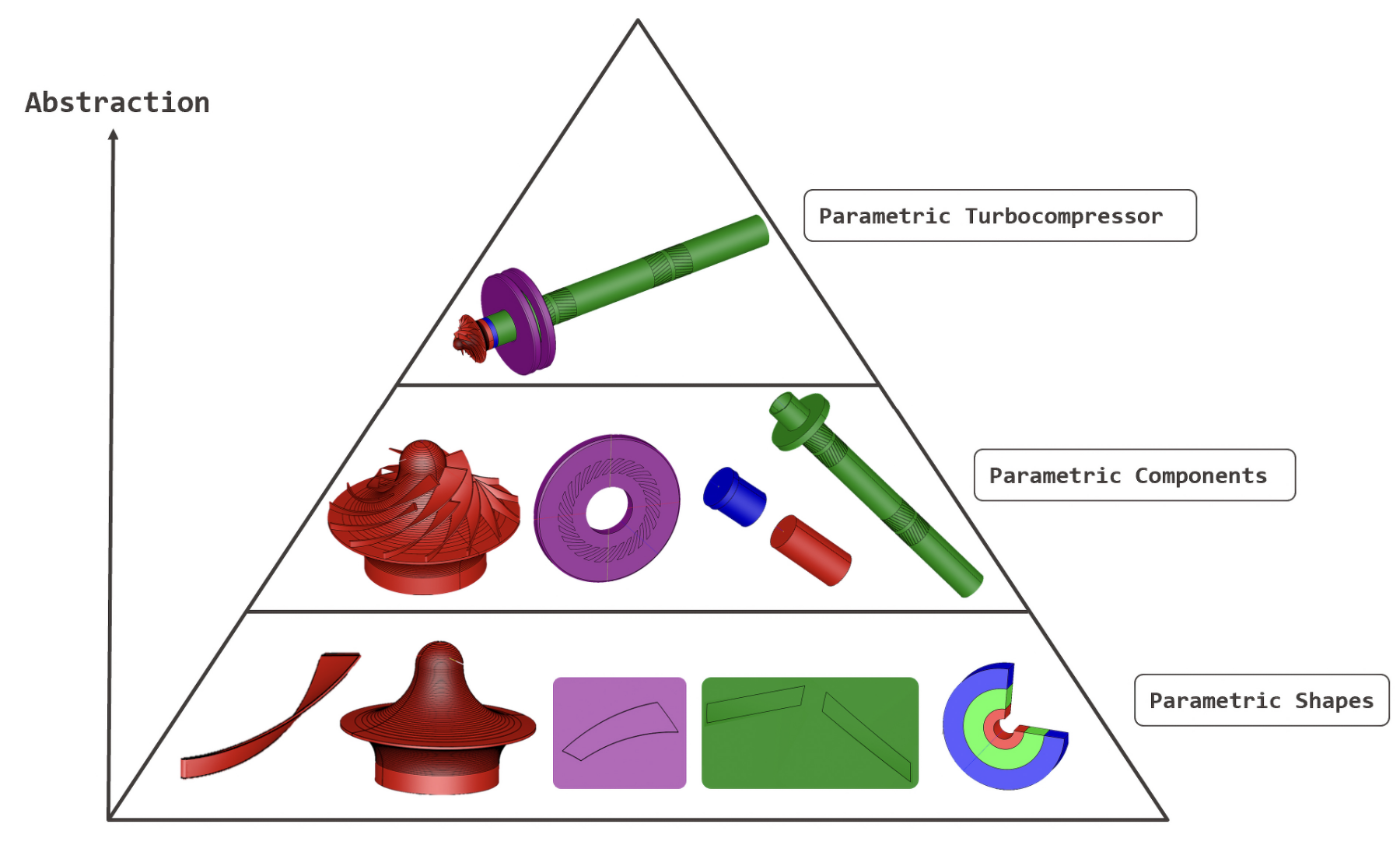
Optimization typically produces abstract parameters rather than geometry that an engineer can inspect or carry into downstream analysis. For a gas-bearing turbocompressor, reconstructing the impeller, rotor, journal bearings, thrust bearing, and assembly manually introduces repeated work and opportunities for inconsistent data transfer.
Method
ParaturboCAD encodes the system geometry in a shared Python parameter structure and uses CadQuery to construct the components and complete assembly. The workflow links optimization output to reproducible STEP and STL geometry without relying on a sequence of manual CAD operations.
The project was developed with Joseph Bejjani, Timothy Horvath, Doğukan Üstün, and Jürg Schiffmann at EPFL.
Results
- Complete parametric construction of impellers, rotor, and gas-bearing components.
- Reported generation time of approximately seven minutes for a complete turbocompressor model.
- Public Python implementation and an open Zenodo dataset of generated assemblies.
- Conference paper at the ASME 2024 Design Automation Conference.
Limitations
The tool demonstrates a reproducible bridge from one-dimensional system parameters to three-dimensional geometry. Its scope is the encoded turbocompressor family; extending it to new architectures requires new geometric parameterizations and validation.