ARMID
Research output: · Journal of Mechanical Design
RoleDoctoral researcher and first author
Background
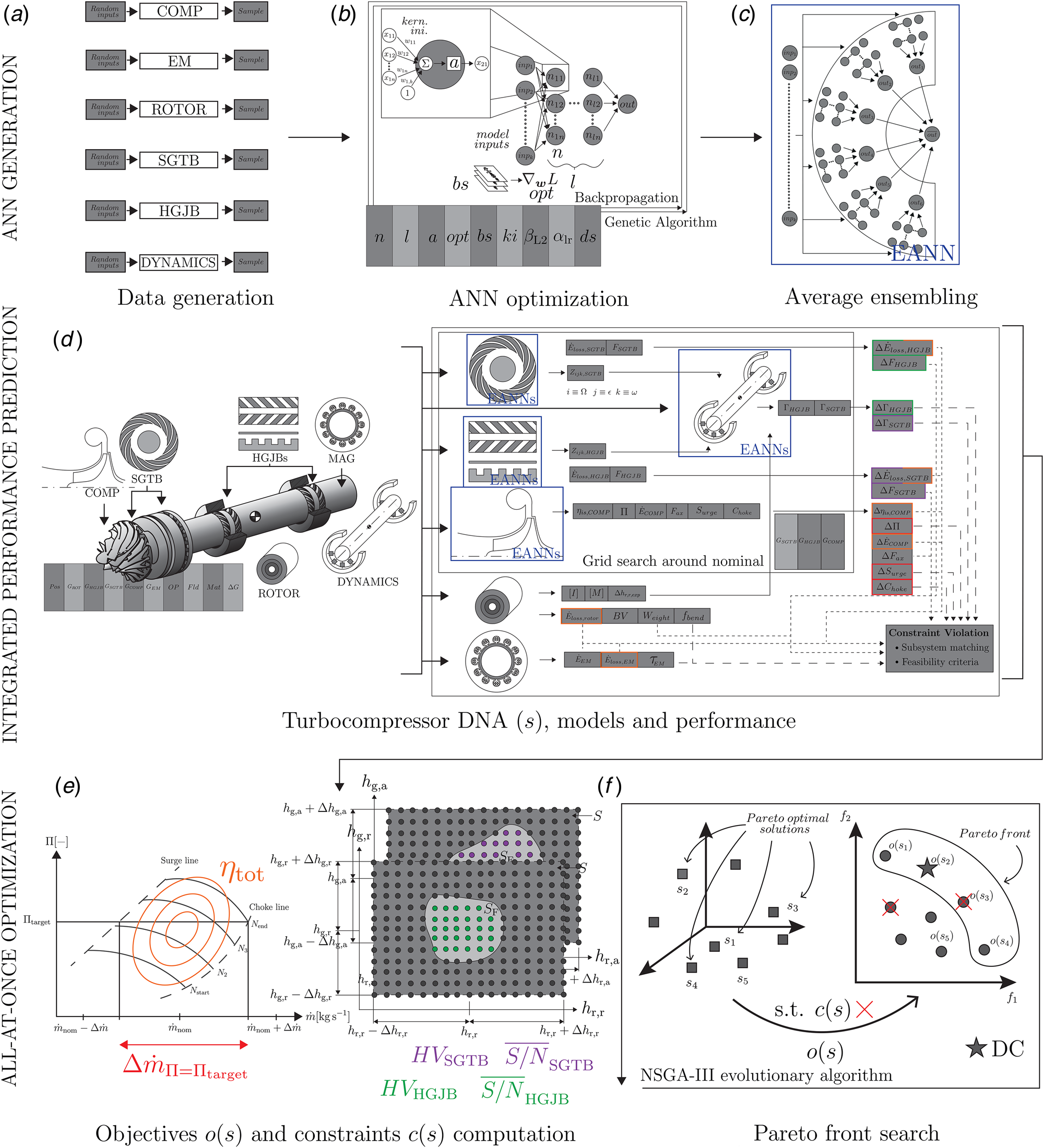
Gas-bearing turbocompressors are tightly coupled systems. Compressor geometry affects performance and operating range; rotor and bearing choices affect stability and losses; manufacturing deviations can invalidate a nominally strong design. Sequential subsystem optimization can therefore produce a poor system-level result.
Method
The doctoral work developed an automated, modular design framework that combines ensemble neural-network surrogates with constrained multi-objective optimization. Compressor, rotor, journal bearings, thrust bearing, and loss models are evaluated together so that robustness competes explicitly with nominal performance.
The work was carried out with Cyril Picard and Jürg Schiffmann at EPFL.
Results
- All-at-once optimization across interdependent physical subsystems and more than twenty reported constraints.
- Explicit treatment of efficiency, operating range, stability, and manufacturing variation.
- Ensemble surrogates used to make repeated system-level evaluations computationally practical.
- Journal, conference, and doctoral-thesis records documenting the progression of the framework.
Limitations
The reported studies use reduced-order and learned models to search the design space efficiently. Candidate designs still require higher-fidelity numerical analysis, engineering review, and experimental validation before manufacture.